How vessel depreciation affects marine insurance premiums
The Depreciation Problem in Marine Insurance
Vessel depreciation is one of the most consequential and least discussed factors in marine insurance premium calculation. Unlike a car or building, a commercial vessel's value follows a complex, non-linear depreciation curve influenced by age, maintenance history, market conditions, vessel type, and trading area. Getting this curve wrong has direct financial consequences for both insurers and vessel operators.
When a vessel is insured for $8 million but its actual market value has depreciated to $5 million, the insurer is overexposed. When insured for $5 million but worth $8 million, the operator is underinsured. Both scenarios create problems — one at claim time, one at renewal. Understanding vessel depreciation insurance dynamics is essential for accurate marine underwriting.
How Ship Depreciation Curves Work
Ship depreciation curves are not linear. Vessels lose value rapidly in the first few years after construction, then follow a slower but accelerating decline in middle age, with a sharp drop in the final years before scrapping. Several factors shape this curve:
Vessel type: Container ships, bulk carriers, tankers, and offshore vessels each follow different depreciation patterns. Container ships tend to depreciate faster due to rapid fleet renewal cycles. Specialized offshore vessels can maintain value longer in tight market conditions but can also lose value rapidly when markets turn.
Market cycles: The shipping market amplifies or compresses vessel values independent of physical condition. A fifteen-year-old Capesize bulk carrier might be worth twice as much in a strong freight market as in a depressed one. Vessel depreciation insurance calculations must account for market-adjusted values, not just time-based depreciation.
Maintenance quality: Two vessels of the same age, type, and flag can have dramatically different market values depending on maintenance history. A well-maintained vessel with continuous classification and no deferred repairs commands a significant premium over a comparable vessel with documented maintenance arrears.
Classification continuity: Class status directly affects market value. A vessel in continuous class with a major society (Lloyd's Register, DNV, Bureau Veritas, ABS) is worth meaningfully more than a vessel with lapsed or suspended class, even if the physical condition is similar.
The Agreed Value Challenge
Most Hull & Machinery policies are written on an agreed value basis — the insurer and insured agree on the vessel's value at inception, and that value is paid in the event of a total loss. This creates a specific depreciation risk for insurers:
If the agreed value is set at the start of a three-year policy term and vessel values decline significantly during that period, the insurer may be paying out more than the vessel is worth at the time of loss. In active claims markets, this overvaluation can be substantial.
The solution is systematic, condition-based valuation at each renewal rather than rolling forward prior agreed values with minor adjustments. When agreed values are anchored to current market comparables, adjusted for condition assessment and depreciation, they track actual vessel value much more closely.
Marine Insurance Premium Factors: Depreciation's Direct Impact
Vessel depreciation affects marine insurance premiums through several mechanisms:
Rate-on-line calculation: H&M premiums are typically expressed as a rate applied to the insured value. As vessels depreciate, the same rate applied to a lower insured value produces lower absolute premiums — but the risk may not have declined proportionally. Older vessels often need higher rates to compensate for increased mechanical risk, partially offsetting the value-driven premium reduction.
Constructive total loss (CTL) threshold: A constructive total loss occurs when repair costs exceed a defined percentage of the insured value. As vessels depreciate, the CTL threshold falls in absolute terms, making CTL declarations more likely for older vessels with significant damage. Underwriters should track the relationship between insured value and likely repair costs as vessels age.
Deductible adequacy: Deductibles are often set as fixed amounts at policy inception. As vessel values decline, a fixed deductible represents an increasing percentage of the insured value. Deductibles should be reviewed at each renewal in the context of current vessel value.
Depreciation Curves by Vessel Type
While every vessel is different, market data supports some general depreciation patterns that inform underwriting benchmarks:
Bulk carriers: Relatively stable depreciation in years 1-10, accelerating decline from year 15 onward as maintenance costs rise and buyers become scarce. Steel prices create a meaningful scrap value floor.
Container ships: Faster early depreciation driven by rapid fleet renewal. Box ships built more than 10 years ago face competitive displacement from newer, more fuel-efficient vessels. Post-2020 sulfur regulation accelerated depreciation for vessels with pre-MARPOL engines.
Superyachts and motor yachts: Depreciation patterns are less predictable than commercial vessels and highly sensitive to brand, condition, and market fashion. Well-maintained premium yachts can maintain value better than commercial vessels of similar age.
Using Condition Data to Adjust Depreciation
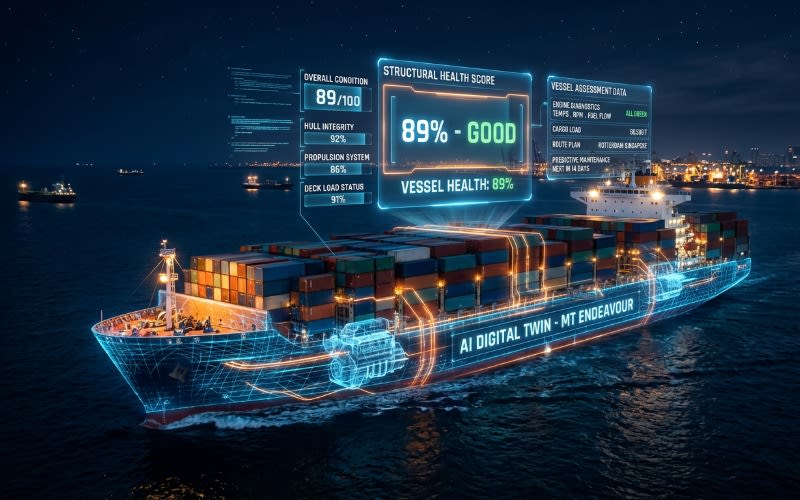
The most accurate approach to vessel depreciation insurance combines market-based depreciation curves with condition-based adjustments. A vessel whose inspection data shows excellent hull condition, well-maintained machinery, and continuous classification should be valued above the age-adjusted market average. A vessel with documented corrosion, deferred maintenance, or lapsed class should be valued below it.
When condition assessment is automated and structured, these adjustments can be applied systematically rather than relying on surveyor judgment. The result is agreed values and premium calculations that more accurately reflect the vessel's true economic position — protecting both insurer and insured throughout the policy lifecycle.